
Panel Intelligence Report
How AI Is Reshaping Design for Spaces: key insights, themes, and takeaways from the panel discussion.
Panel Intelligence Report
Executive Summary
AI changes how design work gets done. It doesn't change who's accountable for it.
Design Intelligence: How AI Is Reshaping Design for Spaces brought together voices from design, technology, operations, and AI education. The panel spent most of its time on the practical questions: who owns the work, how teams should use these tools, and what skills still need to stay human.
For this room, AI is already a working reality. Most attendees had used it somewhere in their process, many that same day, and the conversation moved quickly into harder questions: authority, ethics, craft, and trust.
Bill Houston's 10-80-10™ Framework captured the pattern best: humans shape the first 10%, AI handles much of the middle, and humans return for the final 10% to judge and own the outcome. Bo Pelech added the systems view: the model rarely matters as much as the workflow built around it.
Jesse Hook's read on differentiation: bad work has always been cheap, AI just makes it faster. What clients actually need is someone who can understand the problem, build trust, make decisions, and know when the work is good enough to put a name on.
Ethics showed up as an operating problem more than a philosophical one: clear policies for client data, IP, privacy, and disclosure. The baseline the panel agreed on: don't hide AI use if it could surprise a client later.
The strongest tension was craft. AI can compress the process, but it can also skip the discomfort that builds judgment. The panel's practical close: experiment, start with the low-risk internal work, and spend the time it saves on the parts only a human can do well.
Top Insights
AI Shouldn't Get Final Authority
Bill Houston's 10-80-10™ Framework: humans set direction, AI handles the middle, humans return at the end to judge and own the result. If your name goes on the work, you need to understand how it got there.
Cheap Output Raises the Bar
Jesse Hook: bad work has always been easy to buy, AI just makes it easier to produce at scale. Designers stand out with taste, process, client understanding, and the nerve to say no.
The Model Rarely Wins
Bo Pelech: most teams have access to the same models. The real advantage comes from the system around it, the prompts, review steps, source material, and business rules that shape the result.
Domain Knowledge Is the Moat
Bo Pelech pairs students who can build AI systems with people who own real business problems. AI gets better when it's shaped by people who actually know the work.
Clarity Builds Trust
The panel's rule: be clear with clients about where AI is used, especially with privacy or IP on the line. Jesse Hook's version: no surprises.
Craft Still Needs Reps
The room spent real time on craft: drawing by hand, doing math by hand, learning from senior designers, and sitting in tough review meetings. AI can speed things up, but skill still comes from practice.
Panel Intelligence Report
Human Authority & Accountability
AI can generate the option. The person who ships it still owns the outcome.
Bill Houston's 10-80-10™ Framework gave the room a clear structure: humans set the intent and context at the start, AI takes the heavy middle (summarizing, generating, comparing, organizing), and humans return at the end to judge the work and decide what moves forward.
That final review can't be a rubber stamp. If a client challenges a decision, "the AI gave it to me" doesn't hold up. Whoever presents the work needs to understand the rationale and the tradeoffs behind it.
Jesse Hook's team once rejected 17,000 lines of AI-assisted code a contractor submitted as finished work: "It's not AI's crap, it's your crap." Dumping raw output on someone else is bad process, no matter the tool.
Faster output only helps if the review gets sharper too. Otherwise teams just produce more material for someone else to clean up. The panel's real target was abdication: handing off the part of the job that requires a spine.
Panel Intelligence Report
Systems Beat Single Tools
Most teams have access to the same models. Few build the same system around them.
Bo Pelech: most teams now have access to the same models, so the model itself won't separate one studio from another for long. The real edge comes from the workflow around it, the prompts, review steps, source material, and business rules that shape the result.
That system spans more than AI. It can include client inputs, internal standards, privacy rules, decision logs, and plain non-AI pieces like scripts, spreadsheets, or documentation libraries. Designing the whole workflow matters more than writing a better prompt.
Questions about transparency, authorship, quality control, and data sensitivity get easier once the process has structure. Bo pointed to systems where a decision can be traced back to its original source, down to the granular level.
His advice for getting started: build what you know. Start with a real process, build a small prototype, and let the next step reveal itself. Every studio already has habits and recurring project types worth making explicit.

You're not differentiated by the model. You're differentiated by the system you build.
Bo Pelech
Panel Intelligence Report
Taste Is the Differentiator
AI makes generation cheap. That raises the value of good judgment.
Jesse Hook: bad work has always been cheap. AI just makes more of it, faster, with cleaner edges.
The upside for designers: a good eye becomes rarer as generation gets easier. Someone who can choose well, edit hard, and explain a decision earns more trust than ever.
A good answer, backed by a clear reason to trust it, means more to a client than a stack of options. Bill Houston tied this back to craft: designers still bring the experience, visual sense, and pattern recognition they had before AI. The tool can support those instincts. It can't replace them.
The edge also shows up in client experience. AI can generate a logo or a concept direction. It can't sit with a client, read the room, manage tension, or understand the politics behind a decision.
The work is shifting upstream, toward defining the right problem and defending the final direction. That's the unglamorous part of the job, and increasingly the part that matters most.
Panel Intelligence Report
Learning, Experimentation & Craft
Junior designers still need to be in the room when senior people make hard calls.
Bill Houston's advice: start with low-risk busywork like meeting summaries, client briefs, and documentation. That frees up time for the parts of the job that actually need taste and judgment.
Craft still develops through repetition and exposure to better judgment. Junior designers need to see how experienced people make decisions and defend the work under pressure. They need to be in the room.
Jesse Hook once hand-wrote pages of engineering calculations in university, Red Bull included. Forcing yourself through the steps builds an intuition AI can't shortcut. The same logic applies to hand sketching in design: doing the work teaches you how to judge the work.
The panel's advice was to invest in the skills worth protecting: critical thinking, taste, storytelling, and client relationships. Experimentation also needs a place in studio culture, somewhere people can test tools and share what worked, instead of everyone inventing their own workflow alone.
It's your work. It's your DNA. You need to own it.
Bill Houston
Panel Intelligence Report
Key Questions
When AI generates options, who has the authority to choose?
The human does. Bill Houston's 10-80-10™ Framework: human direction at the start, AI support in the middle, human judgment at the end.
Which parts of the design process should stay human-led?
The brief, the taste calls, the client relationship, and the final decision. AI can help with research, ideation, and production work around them.
How do designers stand out when generation becomes cheap?
By the judgment behind the work: taste, process, and client trust. Those beat a hundred mediocre options.
What role does taste play when everyone has similar tools?
It matters more. AI produces more options than anyone can reasonably use. Taste is what turns volume into direction.
How should studios handle AI use with clients?
Be clear whenever it touches privacy, authorship, or trust. Jesse Hook's rule: no surprises.
What information is safe to put into AI tools?
Start with low-risk, non-sensitive material. Check a platform's data terms before uploading anything confidential or proprietary.
How should teams evaluate which AI tools to use?
Start with what's already in your stack, then test it against real tasks. Weigh cost, privacy, security, and fit with your actual workflow.
How do you protect craft when juniors can jump straight to generated output?
Give them structured practice and access to senior decision-making: critique, hand work, review meetings, and real client context.
How should designers cite the sources behind AI-assisted work?
Track where ideas and references came from, especially with cultural or site-specific material, and pair it with a clear story of how the work got made.
Panel Intelligence Report
Takeaways
AI belongs on the workbench: drafting, sorting, comparing, accelerating. The brief, the judgment, and the final approval stay with the people accountable for the work.
Treat workflow design as part of the job. Clear inputs, review steps, source material, and team standards carry professional work. A loose prompt doesn't.
Start where the risk is low and the drag is high: meeting notes, summaries, research cleanup, documentation, and spreadsheet tasks.
Make disclosure boring. Be plain with clients whenever AI affects privacy, authorship, confidentiality, or trust.
Keep training the eye. Junior designers still need sketching, reviews, tough client conversations, and time around people with better judgment.
Spend the saved time on higher-order work: concept, story, craft, and client thinking. Otherwise AI just makes average work faster.
Never sacrifice excellence for efficiency.
Jesse Hook
Champion AI's Perspective on AI in Design
The work that only you can do? That's what's left.
What used to take days now takes hours. What used to take hours now takes minutes.
You're still creating. Just 10x faster.
Panel Intelligence Report
The Panel
SEGD Chairs

Tim Belanger
Partner, MJMA
Member since August 2019

Dan Glasswick
VP Business Development, Twilight Signs
Member since June 2024

Vivien Lin
Design Director, BrandActive
Member since June 2026

Raymundo Pavan
Senior Experiential Designer, MJMA
Member since August 2010
Panelists

Robert Giusti
UXR Lead
Autodesk

Bo Pelech
Adjunct Professor
Rotman/U of T

Jesse Hook
VP of Ops
SignAgent

Bill Houston
CEO & Innovator
Twilight Signs | Champion AI
Exclusive to Attendees
Free Workflow Optimization
A 30-minute assessment about your day-to-day.
We review what's repetitive in your day-to-day and where the friction actually shows up, then identify which task is the quickest, easiest win to automate.
From there, we design the workflow, provide the implementation instructions, and build it all around the tools and process you already use. All for free.

Book your free assessment
championai.io/schedule-a-call
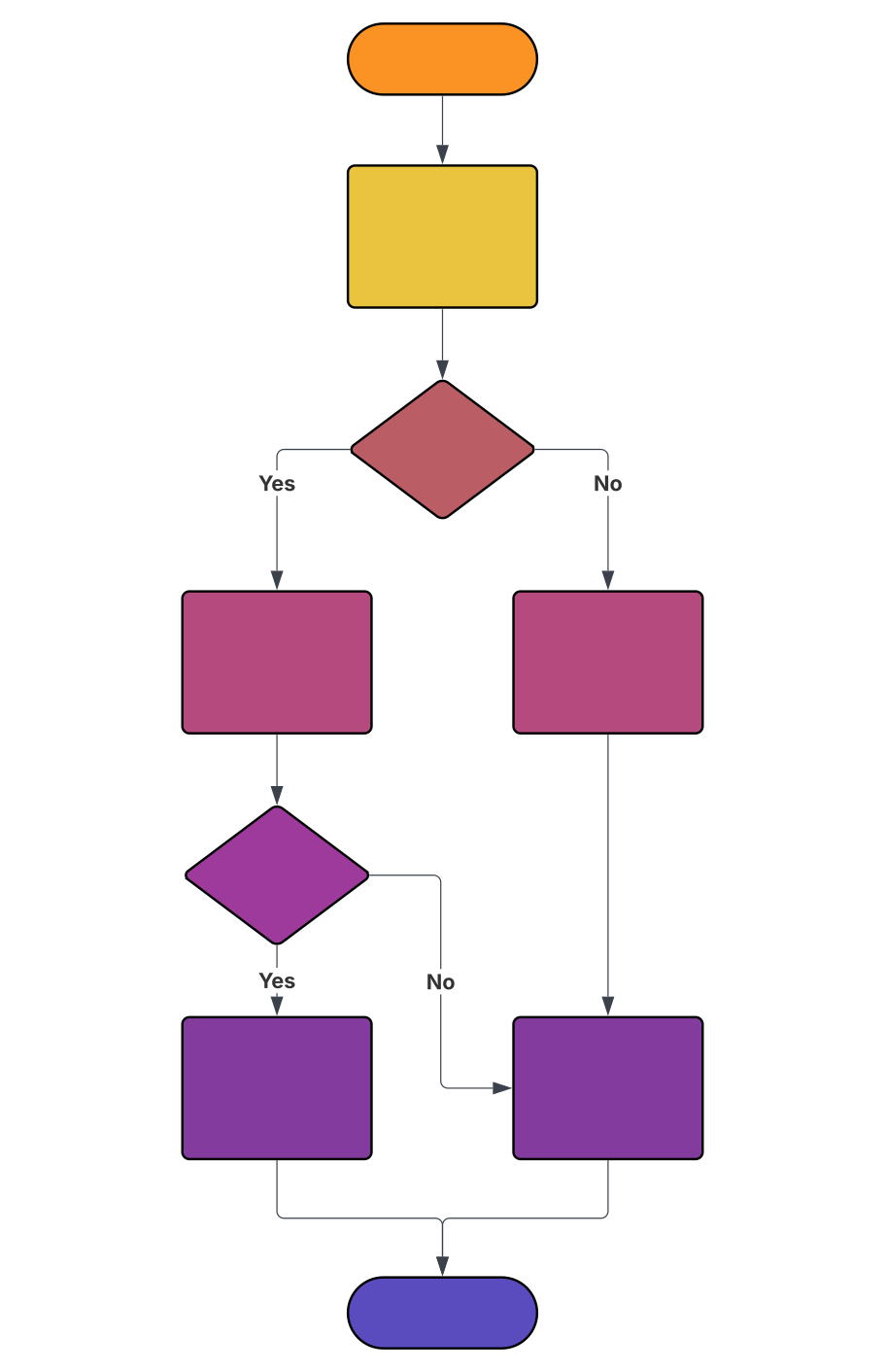
How It Works
Free Resource
When Formatting Drives You Crazy
A custom, ready-made AI instruction set that reads a company's brand from a URL or their brand guidelines, then writes the Google Apps Script for it.
The result: even pasted-in content ends up on-brand.
Instructions
Create a custom assistant in your preferred LLM. This works in ChatGPT custom GPTs, Gemini Gems, Claude Projects, and more.
Save it, then start a new chat.
Give it your company's website URL, or upload your brand guidelines.
Copy the script it generates.
Open a Google Doc, go to Extensions, then Apps Script.
Clear out the default code, then paste in your script.
Save it and go back to your doc.
A new menu appears next to Help, named after your company.
Select your text, click the styling option in that menu, and grant it permission when Google asks.
Watch it reformat in seconds, instead of highlighting every heading by hand.
function onOpen() {
  DocumentApp.getUi().createMenu('[COMPANY_NAME] Tools')
      .addItem('Apply [COMPANY_NAME] Styles', 'apply[COMPANY_NAME_NO_SPACES]Styles')
      .addItem('Format Selection as Arrow Bullet (→)', 'applyArrowBullet')
      .addToUi();
}

function apply[COMPANY_NAME_NO_SPACES]Styles() {
  const doc = DocumentApp.getActiveDocument();
  const body = doc.getBody();
  const paragraphs = body.getParagraphs();

  paragraphs.forEach(para => {
    const text = para.getText().trim();
    if (text === "") return;

    const heading = para.getHeading();

    para.setLineSpacing(1.15);
    para.setAttributes({[DocumentApp.Attribute.FONT_FAMILY]: '[PRIMARY_FONT]'});

    if (heading === DocumentApp.ParagraphHeading.TITLE) {
      para.setFontSize(26).setForegroundColor('[TEXT_OR_PRIMARY_COLOR]').setBold(false);
    }
    else if (heading === DocumentApp.ParagraphHeading.HEADING1) {
      para.setFontSize(20).setForegroundColor('[PRIMARY_COLOR]').setBold(true);
    }
    else if (heading === DocumentApp.ParagraphHeading.HEADING2) {
      para.setFontSize(16).setForegroundColor('[SECONDARY_COLOR_OR_PRIMARY]').setBold(false);
    }
    else if (heading === DocumentApp.ParagraphHeading.HEADING3) {
      para.setFontSize(12).setForegroundColor('[ACCENT_OR_MUTED_COLOR]').setBold(false);
    }
    else {
      para.setFontSize(10).setForegroundColor('[TEXT_COLOR]').setBold(false);
    }
  });

  body.getTables().forEach(format[COMPANY_NAME_NO_SPACES]Table);
}

function format[COMPANY_NAME_NO_SPACES]Table(table) {
  const header = table.getRow(0);
  for (let i = 0; i < header.getNumCells(); i++) {
    header.getCell(i).setBackgroundColor('[PRIMARY_COLOR]');
    let p = header.getCell(i).getChild(0).asParagraph();
    p.setFontFamily('[PRIMARY_FONT]').setFontSize(10).setBold(true).setForegroundColor('[HEADER_TEXT_COLOR]');
  }
  for (let i = 1; i < table.getNumRows(); i++) {
    const row = table.getRow(i);
    for (let j = 0; j < row.getNumCells(); j++) {
      let p = row.getCell(j).getChild(0).asParagraph();
      p.setFontFamily('[PRIMARY_FONT]').setFontSize(9).setForegroundColor('[TEXT_COLOR]').setBold(false);
    }
  }
}

function applyArrowBullet() {
  const selection = DocumentApp.getActiveDocument().getSelection();
  if (!selection) return;
  const elements = selection.getRangeElements();
  elements.forEach(el => {
    const element = el.getElement();
    if (element.getType() === DocumentApp.ElementType.PARAGRAPH) {
      const para = element.asParagraph();
      let cleanText = para.getText().replace(/^[\*\-\•\s→]+/, "");
      para.setText("→ " + cleanText);
    }
  });
}
Get started
You still make the call.
AI just gets you there faster.
AI picks up the admin and the dead-end drafts.
That frees up real time for the decisions only you can make.